# ESP32
| 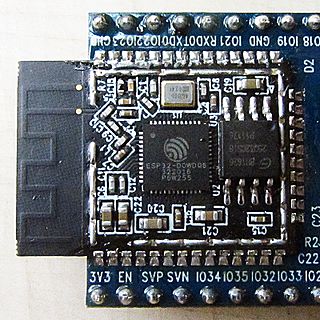 | **ESP32** is a series of low-cost, low-power system on a chip microcontrollers with integrated Wi-Fi and dual-mode Bluetooth. The ESP32 series employs either a Tensilica Xtensa LX6 microprocessor in both dual-core and single-core variations, Xtensa LX7 dual-core microprocessor or a single-core RISC-V microprocessor and includes built-in antenna switches, RF balun, power amplifier, low-noise receive amplifier, filters, and power-management modules. ESP32 is created and developed by Espressif Systems, a Chinese company based in Shanghai, and is manufactured by TSMC using their 40 nm process. It is a successor to the ESP8266 microcontroller. |
|-|-|
| | wikipedia:: [ESP32](https://en.wikipedia.org/wiki/ESP32) |
## [[Artificial Intelligence|AI]]
[Leverage ESP32-S3 AI capabilities with the ESP-DL library - CNX Software](https://www.cnx-software.com/2021/08/29/esp32-s3-ai-capabilities-esp-dl-library/)
> first Espressif wireless processor with AI instructions, and ESP-DL library for ESP-IDF allows you to easily leverage those AI instructions using boards such as the ESP32-S3-DevKitC-1.