# Networking & Internet
| 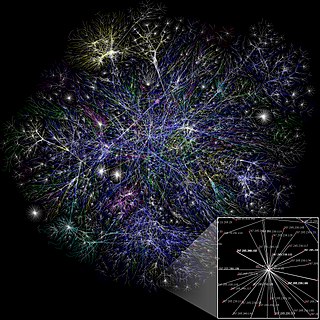 | A **Computer network** is a set of computers sharing resources located on or provided by network nodes. Computers use common communication protocols over digital interconnections to communicate with each other. These interconnections are made up of telecommunication network technologies based on physically wired, optical, and wireless radio-frequency methods that may be arranged in a variety of network topologies. |
| ------------------------------------------------------------------------------------------------------------------------- | --------------------------------------------------------------------------------------------------------------------------------------------------------------------------------------------------------------------------------------------------------------------------------------------------------------------------------------------------------------------------------------------------------------------------------- |
| | wikipedia:: [Computer network](https://en.wikipedia.org/wiki/Computer_network) |
---
## Concepts & Infrastructure
### [[OSI Model]]
### [[TCP IP]]
### [[Physical Network Infrastructure]]
### [[Router]]
### [[Firewall]]
### [[VPN]]
### [[VLAN]]
### [[SSH]]
## [[The Web]] & Internet
### [[Cloud]]
### [[Internet Hosting]]
### [[Message Broker]]
- [[MQTT]]
- [[RabbitMQ]]
- [[Apache Kafka]]
- [[Redis]]
## Architectures & Models
- [[Perimeter-based Security]]
- [[Zero Trust Security Model]]
## [[Network Troubleshooting & Diagnostics]]
## [[Internet of Things (IoT)]]
## Protocols & Standards
- [[Mesh Networking]]
- [[Matter (standard)]]
- [[Thread (network protocol)]]
- [[Personal Area Network]]
- [[Zigbee]]
- [[Z-Wave]]
### Wireless
- [[Radio]]
- [[Wi-Fi]]
- [[Bluetooth]]
- [[Cellular Network]]
- [[Near-field Communication|NFC]]
- [[RFID]]
- [[Ultra-wideband]]
- [[Infrared]]
- [[Li-Fi]]
## [[Distributed computing]], [[Decentralized computing]]
### [[Blockchain]]
## Reliability, SRE, & Availability
### [[Site Reliability Engineering|SRE]]
### [[Load balancing, high availability, fault tolerance, & redundancy]]
- [[High Availability]]
- [[Failover]]
- [[Fault tolerance]]
- [[Proxy Server]]
- [[Scalability]]
- [[Kubernetes]]
## Remote Access
### [[Remote desktop software]]
- [[VNC]]
## [[Communication]]
- [[Telecommunications]]
- [[Communication protocol]]
- [[Email]]
- [[Instant messaging]]
- [[VOIP|Voice messaging]]
- [[Videotelephony|Video call]]
## [[Privacy]], [[Privacy (tech)]], & Anonymity
- [[Tor (network)|Tor]]
- [[VPN]]
## Tools
## Sources
- https://www.udacity.com/course/networking-for-web-developers--ud256
## Inbox
- [[Routing table]]
- [[IP table]]
- SNAT
- [Source Network Address Translation (SNAT) - Technical Documentation - Support - Juniper Networks](https://www.juniper.net/documentation/en_US/contrail2.21/topics/task/configuration/snat-vnc.html)
- [[SDN]]
- DLNA
- [[SNMP]]
- [[UPNP]]
- nat pmp?
- [[Multicast]]
- https://en.wikipedia.org/wiki/Multicast
- [[Maximum Transmission Unit]] (MTU)
- https://en.wikipedia.org/wiki/Maximum\_transmission\_unit
- 0.0.0.0 Vs 127.0.0.1 vs localhost
- https://stackoverflow.com/questions/20778771/what-is-the-difference-between-0-0-0-0-127-0-0-1-and-localhost
- 0.0.0.0 means listen on any available network interface
- link aggregation group, bonding, trunk
- network zone
- edge networking
- Quic
- [[Tunneling protocol]]
[IPsec (Internet Protocol Security)](https://networklessons.com/cisco/ccie-routing-switching/ipsec-internet-protocol-security)
[IP security (IPSec) - GeeksforGeeks](https://www.geeksforgeeks.org/ip-security-ipsec/)