# Friedrich Nietzsche
| 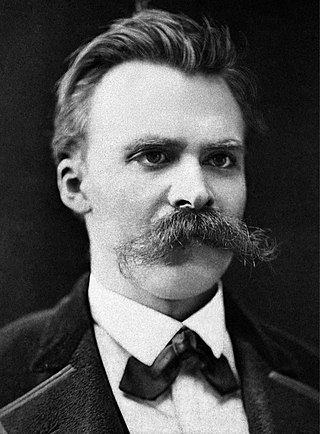 | Friedrich Wilhelm Nietzsche was a German classical scholar, philosopher, and critic of culture, who became one of the most influential of all modern thinkers. He began his career as a classical philologist before turning to philosophy. He became the youngest person to hold the Chair of Classical Philology at the University of Basel in 1869 at the age of 24, but resigned in 1879 due to health problems that plagued him most of his life; he completed much of his core writing in the following decade. In 1889, at age 44, he suffered a collapse and afterward a complete loss of his mental faculties, with paralysis and probably vascular dementia. He lived his remaining years in the care of his mother until her death in 1897 and then with his sister Elisabeth Förster-Nietzsche. Nietzsche died in 1900, after experiencing pneumonia and multiple strokes. |
| ----------------------------------------------------------------------------------------------------------------- | -------------------------------------------------------------------------------------------------------------------------------------------------------------------------------------------------------------------------------------------------------------------------------------------------------------------------------------------------------------------------------------------------------------------------------------------------------------------------------------------------------------------------------------------------------------------------------------------------------------------------------------------------------------------------------------------------------------------------------------------------------------------------------------------------------------------------------------------------------------------------------------- |
| | wikipedia:: [Friedrich Nietzsche](https://en.wikipedia.org/wiki/Friedrich_Nietzsche) |
| | [Philosophy of Friedrich Nietzsche - Wikipedia](https://en.wikipedia.org/wiki/Philosophy_of_Friedrich_Nietzsche) |
| | [Influence and reception of Friedrich Nietzsche - Wikipedia](https://en.wikipedia.org/wiki/Influence_and_reception_of_Friedrich_Nietzsche) |
| | sep:: [Friedrich Nietzsche (Stanford Encyclopedia of Philosophy)](https://plato.stanford.edu/entries/nietzsche/?cmdf=sep+nietzsche |
| | iep:: [Nietzsche, Friedrich \| Internet Encyclopedia of Philosophy](https://iep.utm.edu/nietzsch/?cmdf=iep+nietzsche) |
#form/thought/synthesis Writing style was unique, challenging, blunt, minimalistic, and often with sparse justification for his conclusions, yet could be approachable via his use of [[Aphorism]], [[Humor]], [[Irony]], and [[Poetry (literature)|poetic]] aspects. Often purposefully contradictory, expecting the reader to either solve the dilemma by figuring out his true meaning or to understand the dilemma as the point - to emphasize the significance of the issue, or to simply take the contradiction as the parameters of an ambiguity that is itself the point, e.g. in relation to his emphasis on lived reality and [[Becoming (philosophy)|Process philosophy]] and [[Becoming (philosophy)]] and contra the relative simplicity and arbitrariness of [[Rationalism|rationalistic]] or [[Empiricism|empirical]] conclusions amidst the facts of lived life.
- [[~The point to reading Nietzsche is not to understand him, but to be inspired by him.]]
## Ideas
- [[Nietzsche's Self-overcoming]]
- [[Struggle, Exertion]]
- [[Adversity, difficulty, hardship]]
- [[Suffering, Discomfort]]
- [[Only great pain is the ultimate liberator of the spirit…. I doubt that such pain makes us ‘better’; but I know that it makes us more profound.]]
- [[Conatus]]
- Nietzsche argued for the concept of the [[Will (philosophy)]] contra [[Sigmund Freud|Freudian]] [[Drive theory]] and contra [[Charles Darwin|Darwinian]] [[Gene|Genetic]] fitness or [[Natural Selection]] as the best way to understand [[Life (concept)]]
- Will to Life
- Will to Death
- [[Will to Power]]
- [[The Will to Power]]
- [Philosophy of Friedrich Nietzsche - Wikipedia](https://en.wikipedia.org/wiki/Philosophy_of_Friedrich_Nietzsche)
- The “Will to power” also contains the provisional outline to Nietzsche’s aesthetics as a whole. This has been described as his attempt at a physiology of art where he established the concept of artistic rapture (Rausch).[6] This phenomenon, which is considered a countermovement to nihilism, is for the Nietzsche the force that brings forth not only the form but the fundamental condition for the enhancement of life.[6]
- A progenitor of the science of [[Psychology]] and the philosophy of [[Feminism]]
- [[Perspectivism]]
- [[what we call truth is only a mobile army of metaphors, metonyms, and anthropomorphisms.]]
- [[Sublation]]
- [[Eternal recurrence]]
- [[Become who you are]]
- [[Ubermensch]]
- [[Acceptance]], [[Amor fati]]
- [[Nietzschean affirmation]]
- [[Ressentiment]]
- [[Master-slave morality]]
- [[God is Dead]]
- [[Apollonian and Dionysian]]
- Critical of [[Democracy]], [[Egalitarianism]], classical/social [[Liberalism]], [[Socialism]], and values that are based on the [[Herd behavior|herd]].
- [[World riddle]]
- [[Transvaluation of values]]
## Life
- Suffered a number of chronic health conditions, including stomach pain.
- Would often go on walks in the mountains
## Sources
- [[Nietzsche - The Birth of Tragedy and Other Writings|The Birth of Tragedy]]
- [[On Truth and Lies in a Nonmoral Sense]]
- [[Philosophy in the Tragic Age of the Greeks]]
- [[Untimely Meditations]]
- [[Human All Too Human]]
- [[Nietzsche - Daybreak|Daybreak]]
- [[The Gay Science]]
- [[Thus Spoke Zarathustra]]
- [[Faith in the Earth]]
- [[Codex/Academia/Humanities, Arts, & Social Sciences/Philosophy/Beyond Good and Evil]]
- [[Codex/Academia/Humanities, Arts, & Social Sciences/Philosophy/On the Genealogy of Morals]]
- [[The Case of Wagner, Nietzsche Contra Wagner, and Selected Aphorisms]]
- [[Twilight of the Idols]]
- [[The Antichrist]]
- [[Ecce Homo]]
- [[The Will to Power]]
## Excerpts
- [['True, we love life, not because we are used to living, but because we are used to loving. There is always some madness in love, but there is also always some reason in madness.']]
- Argument from [[Conatus]] and [[Self-reference]]
- [[If we have our own why of life, we can bear with almost any how. Man does not strive for pleasure; only the Englishman does.]] #humor
- [[Meaning of life]]
- [[There are heights of the soul from which even tragedy ceases to look tragic.]]
- [[Elevation (emotion)]]
- [[Without music life would be a mistake.]]
- [[Existentialism]]
- [[Music]]
- "Philosophize with a hammer"
### What Nietzsche respected about Jesus - the possibility for psychological peace, monism, holism, not unlike his moral philosophy
[Criticism of Jesus - Wikipedia](https://donate.wikimedia.org/w/index.php?title=Special%3ALandingPage&country=US&uselang=en)
> However Nietzsche did not demur of Jesus, saying he was the "only one true Christian". He presented a Christ whose own inner life consisted of "blessedness in peace, in gentleness, in the inability for enmity". There is much criticism by Nietzsche of the organized institution of Christianity and its class of priests. Christ's evangelism consisted of the good news that the kingdom of God is within you.[45] "What are the 'glad tidings'? True life, eternal life is found—it is not promised, it is here, it is within you: as life lived in love.... 'Sin', every kind of distancing relationship between God and man, is abolished - precisely this is the 'glad tidings'. The 'glad tidings' are precisely that there are no more opposites...."
- [[Jesus Christ]]
- [[Ubermensch]]
## Related
- [[Ancient Greece]]
- [[The self]]
- [[Philology]]
- [[Psychology]]
- [[Existentialism]]
- [[Silenus|Wisdom of Silenus]]
- [[Continental Philosophy]]
- [[Feminism]]
- [[Religion]]
- [[Christianity]]
- [[Ethics]]
- [[Cultural Criticism]]
- [[Art]]
- [[Aesthetics]]
- [[Poetry (literature)]]
- [[Music]]
- [[Truth]]
- [[Greek tragedy]]
- [[Arthur Schopenhauer]]
- [[Richard Wagner]]
- [[Philosophical pessimism|Pessimism]]
- [[Atheism]]
- [[Free Will]]
## Inbox
## Other Notes Related to `= this.file.name`, `= this.of` or `= this.for` or `= this.re` or `= this.in`
```dataview
TABLE WITHOUT ID
file.link AS Name, in AS In, of AS Of, for AS For, re AS Re, as AS As, contact AS Contact, url AS URL, date AS Date
FROM #Type
WHERE
(
(
any(contains(for, this.for))
OR
any(contains(of, this.for))
OR
any(contains(by, this.for))
OR
any(contains(in, this.for))
OR
any(contains(re, this.for))
OR
any(contains(as, this.for))
AND
this.for
)
OR
(
any(contains(of, this.of))
OR
any(contains(for, this.of))
OR
any(contains(by, this.of))
OR
any(contains(in, this.of))
OR
any(contains(re, this.of))
OR
any(contains(as, this.of))
AND
this.of
)
OR
(
any(contains(of, this.in))
OR
any(contains(for, this.in))
OR
any(contains(by, this.in))
OR
any(contains(in, this.in))
OR
any(contains(re, this.in))
OR
any(contains(as, this.in))
AND
this.in
)
OR
(
any(contains(of, this.as))
OR
any(contains(for, this.as))
OR
any(contains(by, this.as))
OR
any(contains(in, this.as))
OR
any(contains(re, this.as))
OR
any(contains(as, this.as))
AND
this.as
)
OR
(
any(contains(for, this.file.name))
OR
any(contains(for, this.file.link))
OR
any(contains(of, this.file.name))
OR
any(contains(of, this.file.link))
OR
any(contains(in, this.file.name))
OR
any(contains(in, this.file.link))
OR
any(contains(by, this.file.name))
OR
any(contains(by, this.file.link))
OR
any(contains(re, this.file.name))
OR
any(contains(re, this.file.link))
OR
any(contains(as, this.file.name))
OR
any(contains(as, this.file.link))
)
AND file.name !=this.file.name
)
SORT file.etags DESC, date DESC, file.link ASC
```