# Electric battery
| 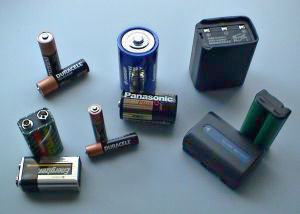 | An **Electric battery** is a source of electric power consisting of one or more electrochemical cells with external connections for powering electrical devices. When a battery is supplying power, its positive terminal is the cathode and its negative terminal is the anode. The terminal marked negative is the source of electrons that will flow through an external electric circuit to the positive terminal. When a battery is connected to an external electric load, a redox reaction converts high-energy reactants to lower-energy products, and the free-energy difference is delivered to the external circuit as electrical energy. Historically the term "battery" specifically referred to a device composed of multiple cells; however, the usage has evolved to include devices composed of a single cell. |
|-|-|
| | wikipedia:: [Electric battery](https://en.wikipedia.org/wiki/Electric_battery) |
Battery management system
## Lithium Ion
- [[Lithium ion battery]]
- [[18650 Battery]]
- Lithium Polymer - LiPo
- [Lithium polymer battery - Wikipedia](https://en.wikipedia.org/wiki/Lithium_polymer_battery)
## Lithium metal
[Lithium metal battery - Wikipedia](https://en.wikipedia.org/wiki/Lithium_metal_battery)
- [[Button cell]]
## Alkaline
- [[Alkaline battery]]
## NiMH
- [[NiMH battery]]
## Nickel-cadmium
## Lead-acid
- [[Lead-acid battery]]
## Sizes
- A
- A23
- AA
- 1/2AA
- AAA
- AAAA
- B
- C
- D
- 9-volt
- Lantern
- CR123A
- CR2
- CR2016
- CR2032
- CR2025
- CMOS battery - usually cr2032
- LR44
- Button cell, coin, watch
- [[18650 Battery]]
## Inbox
- [List of battery sizes - Wikipedia](https://en.wikipedia.org/wiki/List_of_battery_sizes)
- [Battery holder - Wikipedia](https://en.wikipedia.org/wiki/Battery_holder)
- [Battery recycling - Wikipedia](https://en.wikipedia.org/wiki/Battery_recycling)