# Reverse Proxy
| 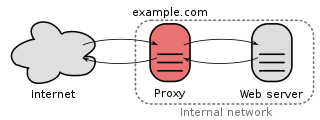 | In computer networks, a **Reverse Proxy** is an application that sits in front of back-end servers and forwards client requests to those servers instead of having the client directly talking to the servers. Reverse proxies help increase scalability, performance, resilience and security. The resources returned to the client appear as if they originated from the web server itself. |
|-|-|
| | wikipedia:: [Reverse proxy](https://en.wikipedia.org/wiki/Reverse_proxy) |
- https://stackoverflow.com/questions/224664/difference-between-proxy-server-and-reverse-proxy-server
- Contra forward proxies, with reverse proxies, the client doesn't know about the server at the end of the chain that the reverse proxy gets resources from
## Functions
- [[Load balancing, high availability, fault tolerance, & redundancy|Load balancing]]
- [[CDN]]
## Tools
- [[Apache HTTP Server]]
- [[Nginx]]
- [[Nginx Proxy Manager]]
- [[HAProxy]]
- [[Caddy (web server)|Caddy]]
- [[Traefik]]
- [[Secure Web Application Gateway (SWAG)]]